
49-Day Prayer Ceremony for the Recently Deceased (安灵 / 祭祀)
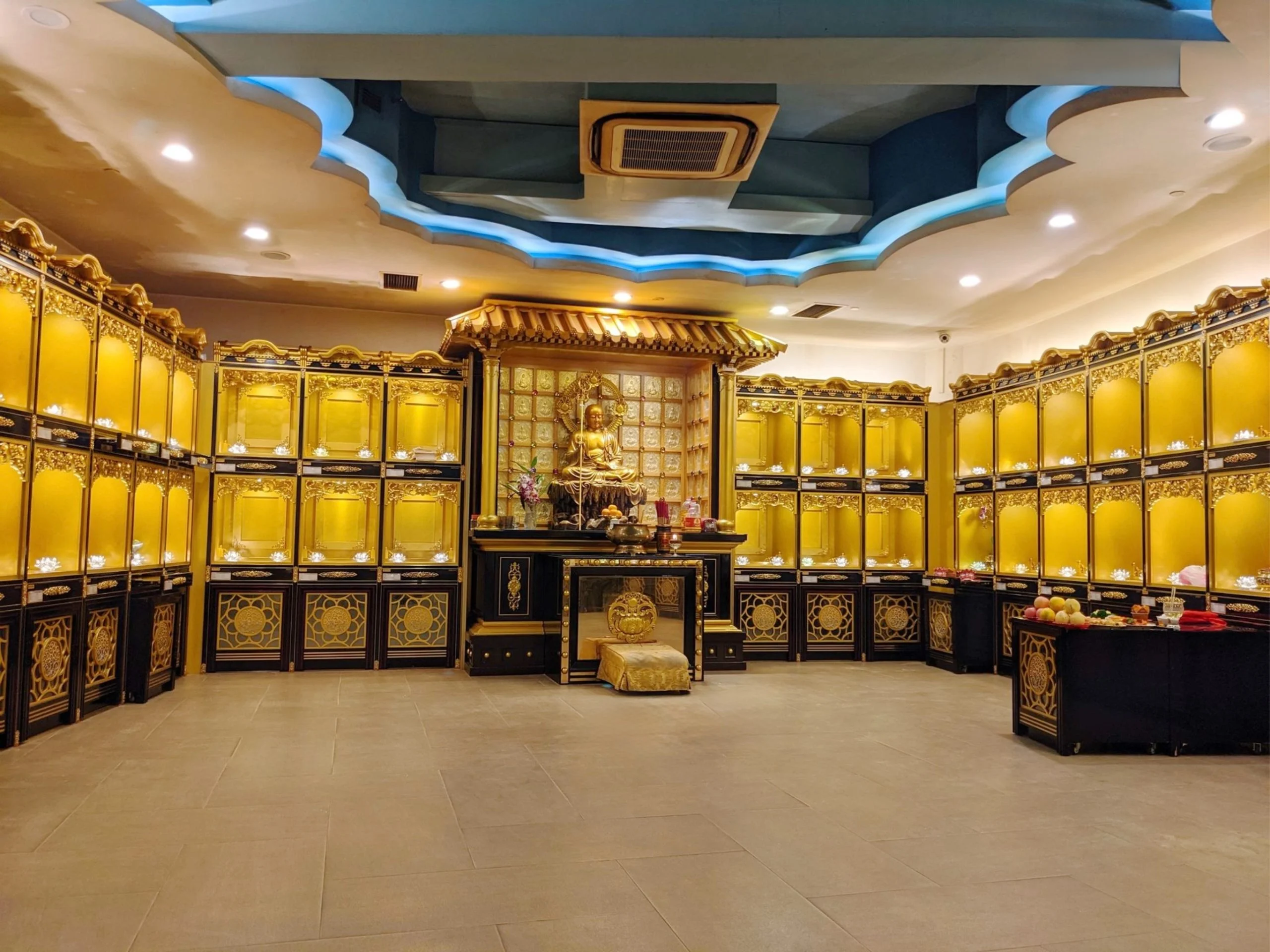
The (安灵 / 祭祀) prayer service spans 49 days, offering a sacred time to honour and remember a newly departed loved one. In a specially prepared space, family and friends can gather to pay their respects and keep their memory close. Throughout this period of grief and healing, our dedicated specialists provide continuous care and support. The final day signifies the completion of the journey, gently guiding the living towards acceptance and peace.
What the 49 Days After Death Mean
In Chinese Buddhist understanding, a person does not pass directly from death to their next life. There is an interval in between — the intermediate state, 中阴 (zhong yin) — during which the consciousness of the departed has not yet taken rebirth. That interval lasts at most forty-nine days. The number is not arbitrary: it is the length of the passage itself.
What the family does during those weeks — chanting, offerings, acts of merit — is understood to be transferable to the departed, easing their passage. This is the heart of the observance. It is not only remembrance; it is the belief that the living can still act on behalf of someone at the moment it matters most.
Why Seven Periods of Seven Days
The forty-nine days are counted as seven periods of seven, with a prayer observance on each seventh day. The practice is called 做七 (zuo qi), "doing the sevens." The first of them, 头七 (tou qi), falls on the seventh day after death, and is traditionally when the departed is believed to return home — families lay out a meal, keep a light burning, and wait. The observances then repeat every seventh day.
The seventh of them — the forty-ninth day, 满七 (man qi) or 七七 — closes the passage. It is usually the largest of the observances, and it marks a turning point for the family as much as for the departed. Prayers continue afterwards at the hundredth day, the first anniversary and the third, but their character shifts from accompanying to remembering.
What 安灵 (An Ling) Means
安灵 (an ling) means, literally, to settle the spirit — to give it a place. During the mourning period a spirit tablet is installed for the departed, either at home or in a memorial hall, and it becomes the focus for chanting, incense and offerings. 安灵 is not a single ceremony on a single day. It is the arrangement that holds for the whole forty-nine days, so that there is always somewhere for the family to go.
Chinese Custom and Buddhist Practice
Many families in Singapore are working with two inheritances at once. The Buddhist observance rests on doctrine — the intermediate state, the transfer of merit — and is led by monastics whose chanting is directed at the welfare of the departed. The folk Chinese practice of 做七 is older and broader, concerned with filial duty and the continuity of the family line: offerings laid out, joss paper burned, incense offered in order of seniority.
In practice the two run together more often than not, and they do not conflict. Where a family holds different faiths, each member can usually take part in their own way. We do not ask families to choose between them — we arrange according to how your family already does things. If you are also planning the funeral itself, our Buddhist funeral packages cover the wake and cremation, and the 49-day observance follows on from there.
Cost of a 49-Day Prayer Ceremony
- Niche customer: Free
- Pedestal customer: $388
- Others: $1,888
Prayer services for the first year after passing
We provide a range of Chinese prayer and memorial services from the time of passing up to the first year. These services are designed to respect tradition while fitting modern practices in Singapore.
Services include:
- Prayers to settle the spirit of the departed
- Respect paying and offering rituals
- End of mourning prayers
- Shi Jin (bone picking and relocation of remains)
- Changing of urn
- Placing the urn into a niche
- Setting into the ancestral tablet
- Zuo Qi
- 100-day prayer service
- Anniversary prayer services
- Dui Nian
- 3rd-year memorial prayer service