
A meaningful part of the 7th Month prayer services at Nirvana Memorial Garden Singapore is the inclusion of 瑜伽焰口 Yu Jia Yan Kou and 面燃大士 Mian Ran Da Shi. The first is a Buddhist rite that feeds and teaches the hungry ghosts. The second is the deity believed to oversee the spirits who return during the seventh lunar month. Together they reflect the compassionate purpose of Hungry Ghost Festival prayer services, which are dedicated not only to ancestors and loved ones, but also to wandering souls and beings in suffering. This article explains what each one is, what happens during the rite, and why both belong in the ceremony.
瑜伽焰口 Yu Jia Yan Kou: An Offering to the Hungry Ghosts
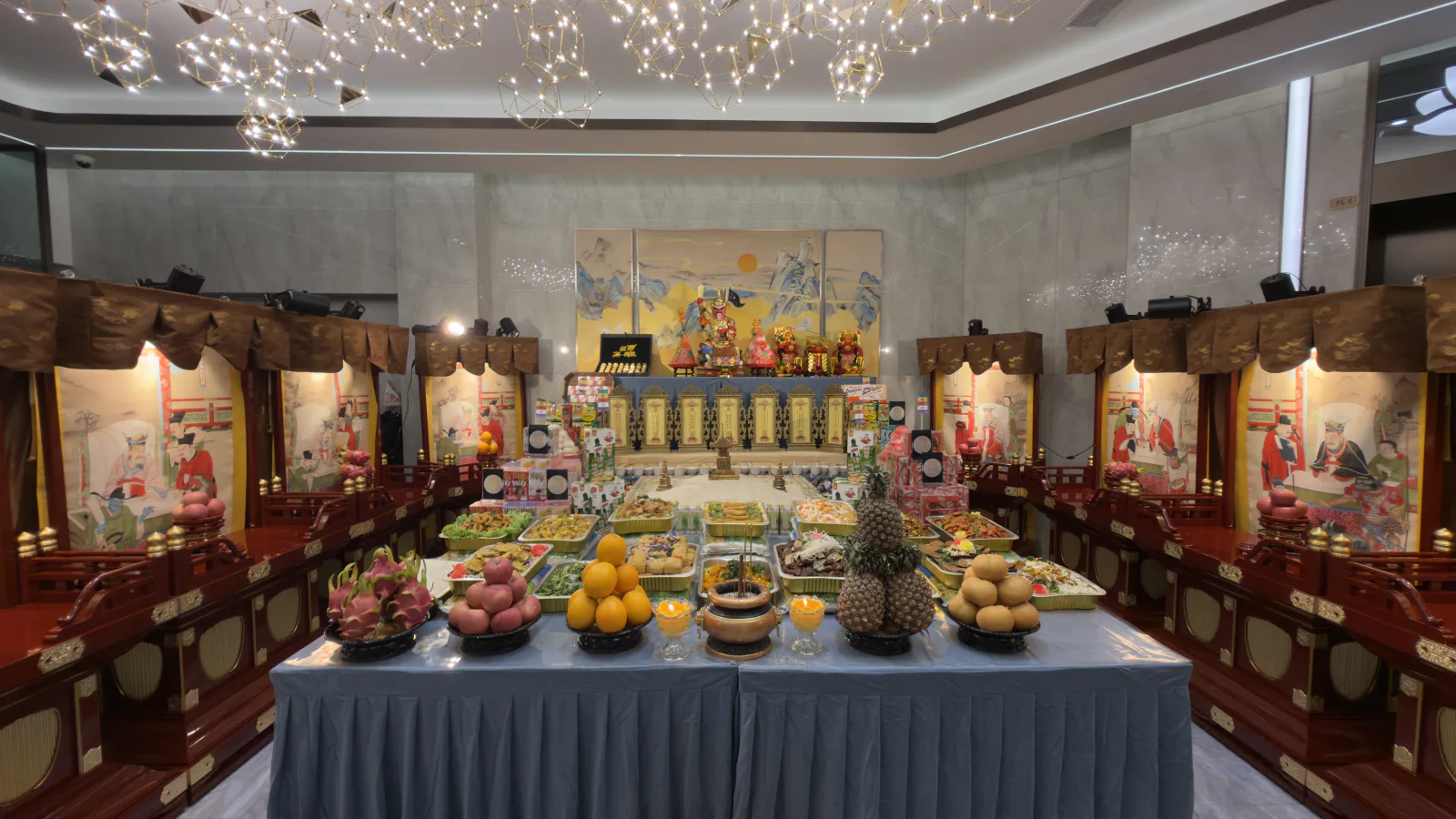
Yu Jia Yan Kou is an important Buddhist ritual performed during 7th Month prayer services to offer food and blessings to hungry ghosts. It is rooted in the Dharani Sutra for Rescuing the Flaming-Mouth Hungry Ghosts (救拔焰口饿鬼陀罗尼经), and its purpose is to relieve the suffering of beings in the hungry ghost realm, who are described as tormented by a hunger and thirst they cannot satisfy on their own.
The name itself explains the method. 瑜伽 Yoga is a transliteration from Sanskrit and here means the union of the three karmas: the hands form mudras, the mouth recites mantras, and the mind holds a visualisation, all working as one. 焰口 Yan Kou, "flaming mouth", is the name of the hungry ghost whose plight prompted the sutra. Its throat was as narrow as a needle and its mouth burned so fiercely that no food could pass. The rite is a means of reaching beings in exactly that condition.
What Happens During the Yan Kou Rite
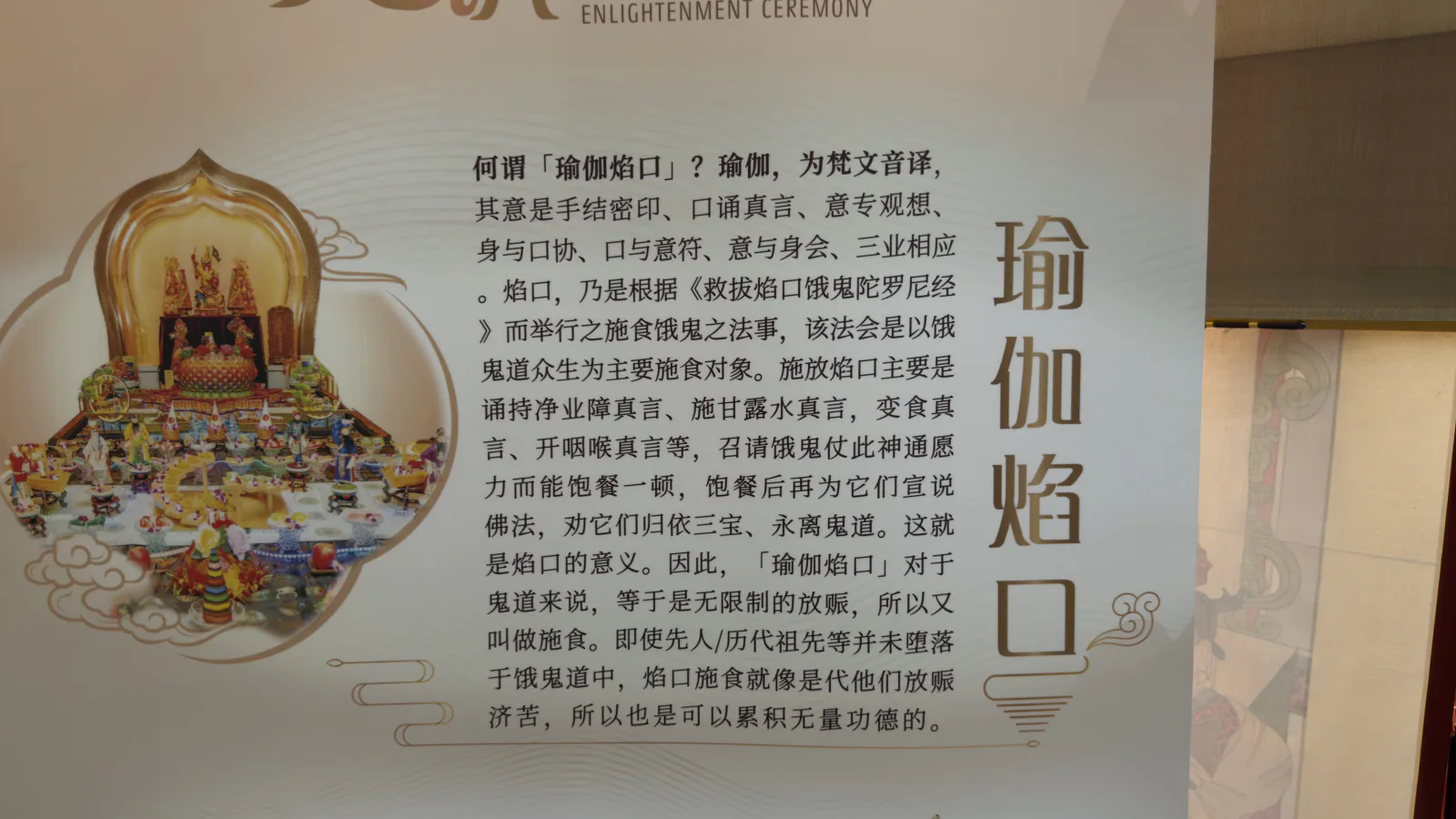
The officiating monks chant a sequence of sacred mantras, each with a specific role. Mantras to purify karmic obstacles (净业障真言) clear the way. The sweet dew water mantra (施甘露水真言) offers relief from thirst. The food transformation mantra (变食真言) multiplies the offerings so that they become inexhaustible. The throat-opening mantra (开咽喉真言) symbolically allows the hungry ghosts to swallow and be nourished. Through the power of these mantras the spirits are believed to receive a full meal, something ordinary offerings alone could not give them.
Feeding is only half of the rite. After the offering of food, Dharma teachings are shared with the assembled beings, urging them to take refuge in the Three Jewels (the Buddha, the Dharma and the Sangha) and to leave the ghost realm for good. This is why the Yan Kou is sometimes described as unrestricted almsgiving (放赈) for the unseen realm: it feeds whoever comes, and it points every one of them toward liberation.
This makes Yu Jia Yan Kou one of the most compassionate elements of Hungry Ghost Festival prayer services. It is an act of generosity that extends care beyond one's own ancestors to all beings in need. Even when a family sponsors the rite on behalf of departed relatives who may never have fallen into the hungry ghost realm, the offering is made in their name, like almsgiving carried out on their behalf. The merit generated is believed to be immeasurable and to be dedicated to them directly.
面燃大士 Mian Ran Da Shi: The Deity Who Oversees the Seventh Month
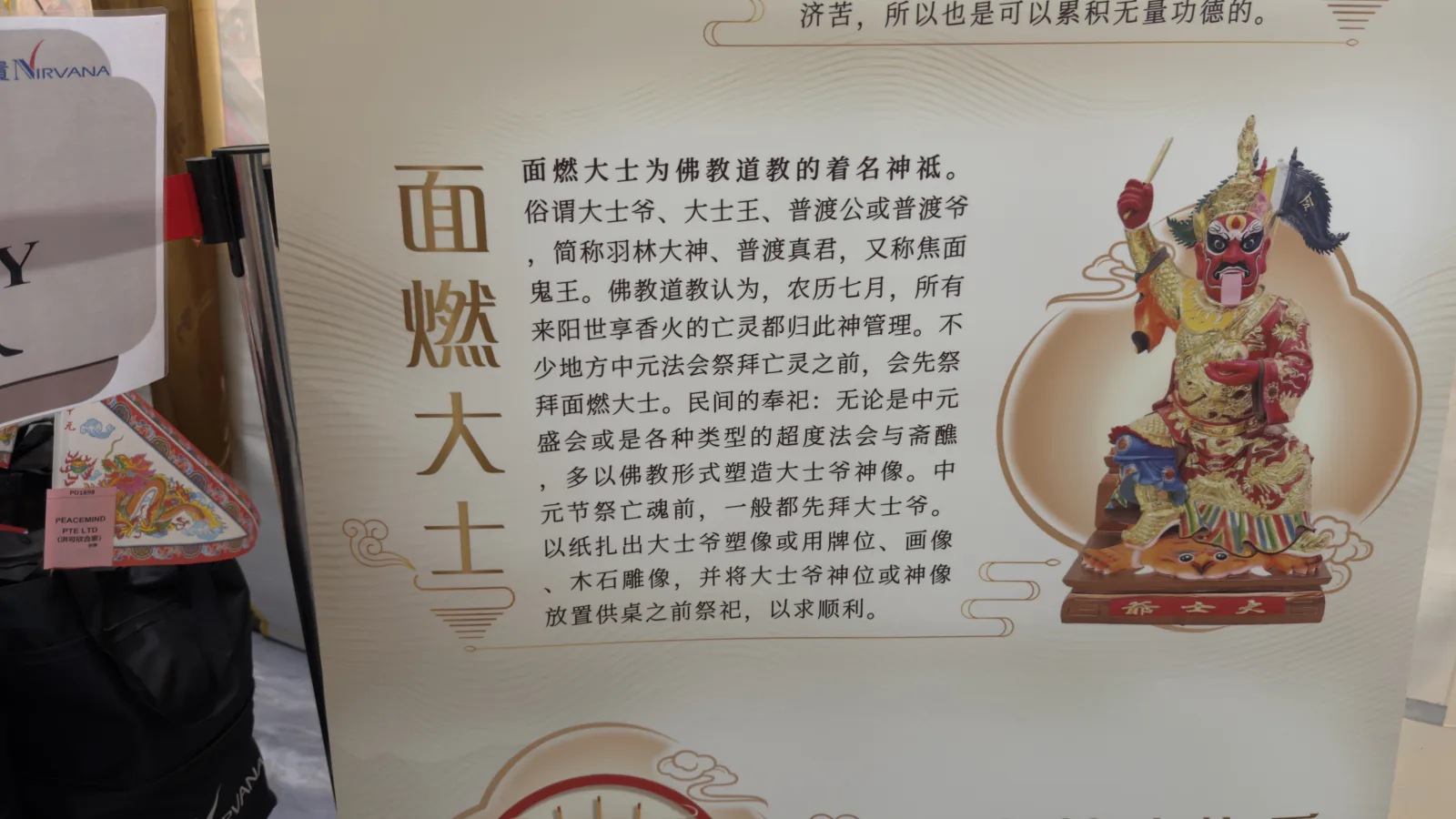
Following the Yan Kou, another important presence in 7th Month prayer services is 面燃大士 Mian Ran Da Shi, a well-known deity in both Buddhist and Taoist tradition. He goes by many names in Singapore and across the Chinese world: 大士爷 Da Shi Ye, 大士王 Da Shi Wang, 普渡公 Pu Du Gong, 普渡爷 Pu Du Ye, 羽林大神, 普渡真君, and in Buddhist usage 焦面鬼王, the Burning-Faced Ghost King. In Buddhist tradition he is often regarded as a wrathful manifestation of Guanyin Bodhisattva (观音大士), which is why he carries the honorific 大士.
He is believed to oversee the spirits who return to the human world during the seventh lunar month to receive offerings. In the folk understanding, every soul that enjoys incense and food during this month does so under his supervision. Many Zhong Yuan ceremonies therefore begin by paying respects to Mian Ran Da Shi before any offering is made to the departed themselves, so that the proceedings are conducted in good order.
His Place at the Offering Table
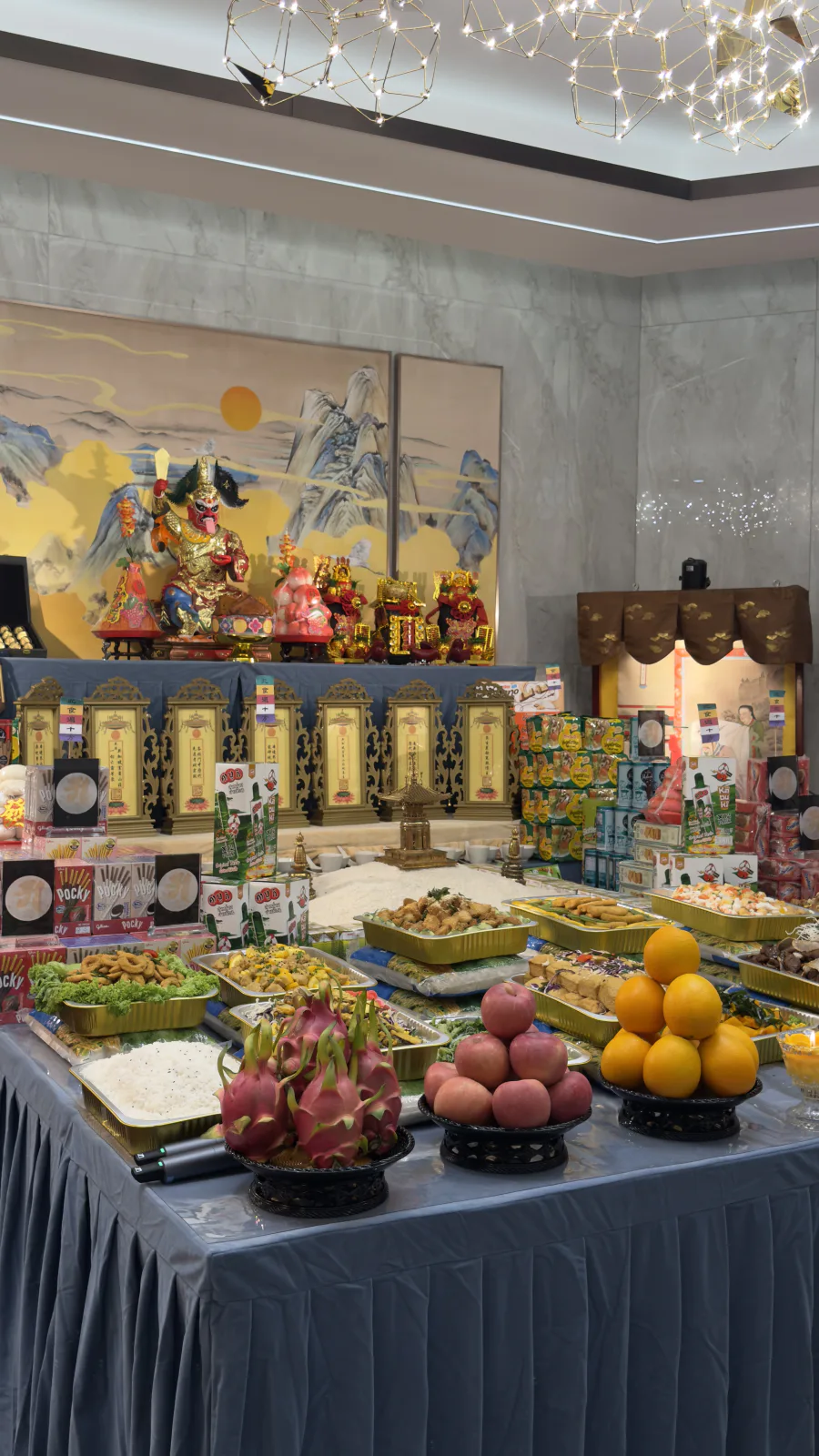
In many traditional Hungry Ghost Festival prayer services, an image of the deity is set up before the offering table. It may be a paper effigy, a painted image, a tablet bearing his name, or a carved figure in wood or stone. At Nirvana's ceremony hall the image stands at the head of the long table of fruit, rice and packaged food, flanked by the paper houses 同归所 Tong Gui Suo and 寒林院 Han Lin Yuan that shelter the wandering souls. His fierce expression is not meant to frighten the living. It symbolises supervision, order and protection throughout the ceremony, and signifies that the offerings will be received by the unseen realm in an orderly way.
Everything on that table, from the deity's image to the sacks of rice, is part of the ceremony's communal offering and is arranged by the organisers. Families attending do not prepare anything for Da Shi Ye or the wandering souls themselves. Their part is expressed through the tablets they register and the merit that is dedicated in their relatives' names.
Why the Two Belong Together
Yu Jia Yan Kou and Mian Ran Da Shi answer two different needs of the same occasion. The Yan Kou provides the substance of the ceremony: food that can actually be received, and teaching that can actually set beings free. Mian Ran Da Shi provides its structure: an assurance that the gathering of souls will be orderly, protected and complete. One without the other would leave the ceremony either generous but unguarded, or orderly but empty.
At Nirvana Memorial Garden, the inclusion of both in the 7th Month prayer services highlights the deeper meaning of these observances. Beyond remembrance, the prayer services embody compassion, spiritual guidance, and the sincere wish that all departed souls, named and unnamed, may receive peace, blessings and deliverance.
Questions Families Often Ask
Is the Yan Kou a Buddhist or a Taoist rite? Yu Jia Yan Kou is Buddhist in origin and is performed by monks. Taoist tradition has its own parallel rites of feeding and universal deliverance (施食, 普渡), and Mian Ran Da Shi is honoured in both traditions. Families of either faith will find the ceremony familiar.
Can I take part in the Yan Kou for a specific relative? Yes. Once a family registers a memorial tablet for the ceremony, the offering and the merit are dedicated in that relative's name. Families who would like a dedicated merit ceremony for their loved one can also arrange a separate Kong Teck ceremony.
Do I have to attend in person? Families are welcome to join the chanting and witness the rite. If you cannot be there, you can still register a tablet and the merit is dedicated all the same, or use the pray-on-behalf service so that incense and offerings are presented for you.
Why does Da Shi Ye look so fierce? A wrathful appearance is common to protective figures in Buddhist art. It is meant to keep restless spirits in check and safeguard the order of the ceremony, not to threaten the living. Devotees regard him as a compassionate guardian, and there is nothing for children to fear.
Taking Part in the Yan Kou at Nirvana
The Yan Kou and the honouring of Mian Ran Da Shi are fixed parts of the Zhong Yuan deliverance ceremony that Nirvana Memorial Garden holds each Seventh Month, running over several consecutive days on Level 9 of Block B. To include a departed relative in the feeding rite, a family registers a single ceremony tablet. On the day they may join the chanting and watch the rite, or simply sit quietly in the hall. Families whose loved ones already rest at Nirvana, whether in a niche or on an ancestral tablet, often find this the most personal moment of the year. This year's dates, tablet registration and fees are quickest to confirm over WhatsApp at +65 8999 7708, or start with the overview on our prayer services page.